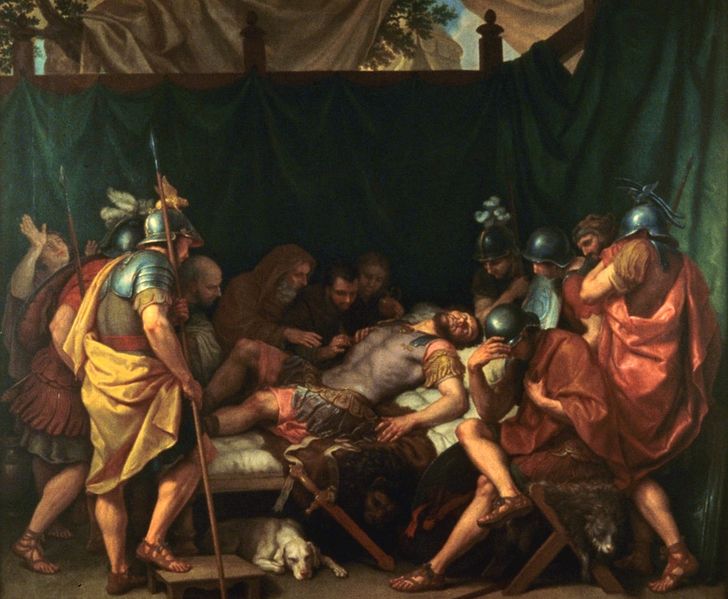
The Death of Germanicus 2: a Study in Roman Witchcraft

It is very risky to talk about ‘witchcraft’ at all.  It means so many different things to different people.  Everything I write is based on things in my library and I going to look at a passage of Tacitus and use it to explore practices within Roman culture which later scholars call ‘witchcraft’.  So don’t expect anything about Wiccanism, Satanism, coven witches and many other things commonly associated with the term ‘witchcraft’.  I am going to write about the Roman belief that people could exercise power over others by indirect and non-rational means, which we would call ‘magical’.  The Romans seem to have regarded this sort of practice as a common source of harm.  In their literature, practitioners are always regarded as dangerous, but their criminal law legislated against particular ‘magical’ crimes, not being a ‘witch’.   At the end of the post I will ask how appropriate the Anglo-Saxon term ‘witchcraft’ is.

Roman practitioners  of these disapproved arts invoked gods and spirits, but in ways condemned by the community.  Their behaviour was distinguished from the good and proper relations with the gods, which the Romans called religio or religion, although there was an overlap.  The gods of the upper world were associated with light and life and had nothing to do with the pollution of death.  Everyday petitionary prayers went to them.  The dreaded underworld gods were associated with death, misery and darkness and their worship involved nocturnal rituals and the sacrifice of black animals and even the sacrifice of dogs – unclean for normal sacrifice. But all this was part of normal religion – the gods concerned with both light and dark deserved their dues.

We only enter the realm of evil when engagement with the underworld deities moves from the community propitiating them in the proper ways to individuals calling upon Hecate, Dis and infernal spirits secretly and harnessing their power to evil ends, especially towards causing sickness and death.   The Roman sources tell of  forbidden and polluting rites, carried out at night, and including the desecration of dead bodies.  Practitioners were supposed to use harmful incantations.  They also made potions and objects which gave them special powers, especially control over others.  The sources have to be used with caution, but there is strong evidence that these practices did actually exist.  Practitioners were not regarded as having an alternative religion – instead they had illicit commerce with the gods of the religion of the community.

The Latin word we usually translate as ‘witchcraft’ is maleficium – harm-doing, a word which could also be used of harm in general.  Practitioners were malefici  ( female maleficae = harm-doers).  Rome’s oldest laws the Twelve Tables, exist only in fragments but seem to have included, with other crimes against persons and property, enchanting by an ‘evil song’ (malum carmen) and removing crops by enchantment, again by song (qui fruges excantassit).  The references come from Table VIII 1b; 8a quoted in Pliny NH 28. 4). Later legislation follows the same pattern and specifies the banned ‘magical’ practices without distinction, alongside other forms of harm, such as arson and stabbing.   The Romans did not call these practices ‘magic’.  The Latin word magia from which we get ‘magic’ meant something also suspect, but different from maleficium, namely astrology.  In legal texts, the key indicator that we are talking about ‘magical’ harm is usually the association of harm with singing in some way – particularly the malum cantum, the ‘evil song’.  But this is misleading, as we shall see below.  Mentioning ‘evil singing’ identifies the kind of harm that is going on, but Romans assumed that it would be accompanied by a other acts from a wide range of options, including, at the least, ritual activity while the song was sung.

Returning to Germanicus, this magical indirect harm-doing was strongly associated with an undoubted way of doing criminal harm at a distance – poisoning.  A poison is definitely a potion which gives you control over others.  The Romans did have a concept of poison (venenum) as separate from other  malefica (‘magical’ harm-doing things), as the passage below shows, but in the absence of advanced chemistry, it made perfect sense to reinforce the drug with occult methods, which may have gone even into its preparation.  It is not surprising that people adept in poisoning were expected to be adept in other forms of harm at a distance.  Tacitus account of the death of Germanicus is good evidence of the inseparability of poisoning and maleficium in the Roman mind.  It also shows the sort of harm-working things (malefica) which would accompany the evil song.

The terrible intensity of the malady was increased by the belief that he had been poisoned by Piso. And certainly there were found hidden in the floor and in the walls disinterred remains of human bodies, incantations and spells, and the name of Germanicus inscribed on leaden tablets, half-burnt cinders smeared with blood, and other horrors by which in popular belief souls are devoted to the infernal deities. Piso too was accused of sending emissaries to note curiously every unfavourable symptom of the illness.  Tacitus Annals 2. 69

The first symptom of poisoning is, obviously, serious and sudden illness. In the ancient world allegations of poisoning almost invariably accompanied the sudden death of significant figures.  Tacitus likes to cite evidence.  Here he notes Germanicus’ own belief and the curiosity of Piso as circumstantial evidence.  But he also cites as supporting evidence for Germanicus’ belief a bizarre array of nasty objects hidden in the house where Germanicus died.  These, it seems, are the sort of things which may accompany a poisoning.  Tacitus refers to these briefly, because they are well known (in popular belief) and even leaves some for the reader to supply.  He calls the cursing objects collectively malefica – ‘harm-working things’.  Tacitus’ lack of surprise and his assumption that the reader can supply the details of other horrors is extremely interesting – in his Roman mind these bizarre proceedings are a familiar modus operandi.

So what are the malefica?  The human remains look like graveyard pilferings – a common accusation against harm-workers’, and a serious assault on the safety of the dead The cinders combined with gore (tabo) come specifically from the cremation grounds. Human remains were polluting in the Roman world.  Prayers to the upper world gods could not be made in their presence, and so the objects must have compromised the religious safety of Germanicus’ household.  There may also be an attempt to make Germanicus dead by bringing him into contact with the dead.  Below, we shall see this in the case of a different spell.  But it would not be irrational to suppose that polluting a house with human remains would also cause illness.  The finding of the objects concealed in walls and floor is suggestive.  Did Romans often look for malefica in case of sudden illness?  Or did the objects leak and smell?  Did someone know where to look for them?  Were they meant to be found?

The Latin Tacitus uses for ‘incantations and spells’ is carmina et devotiones.  We have met the malum carmen (plural carmina), the ‘evil song’ as the key ingredient of maleficium.  Clearly there might be literal singing, but in this passage of Tacitus we see that writing charms down and placing them in contact with the victim was effective too.  Writing was a powerful vehicle; you could harm your victim both by placing harmful words in your victim’s presence, and by capturing your victim’s name and using it in harmful ways.  And of course, with this kind of access to the victim, harm-workers could support the carmina lavishly with other malefica, and help the spell along with physical means, like poison.
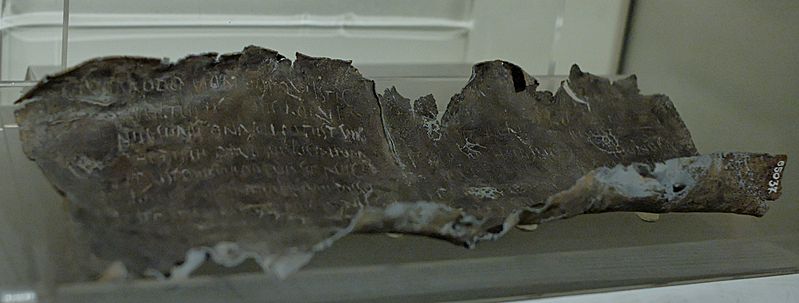
799px-Defixio_Rhodine_Faustus_Terme
Defixio against Rhodine, from the Baths of Diocletian, Rome

The reference to leaden cursing tablets, defixiones, can be supported from archaeology.  We find cursing tablets deposited by people with grievances in sacred places – usually in water, but, of course, ones thrown into water are preserved best.  The defixio, sometimes in backwards writing, encourages the deity of the shrine to punish the enemy.  Seen by  itself, placing defixiones in shrines could be no more than an emphatic form of negative prayer.   It hardly required secret knowledge.  The gods of the dead were not invoked over the affairs of the living – a transgressive feature of maleficium.  There was, at face value, no  malum carmen, although we cannot know what rituals may have accompanied the defixio.  The physical tablet may only be part of the story, as it is in Tacitus.

Tacitus also mentions devotiones.  The defixio above looks fairly typical.   But it is different because of its content and its location –  it was found in a graveyard and contains a special form of curse – the devotio – which offers possession of the victim to underworld spirits..  On the tablet Marcus Licinius Faustus consigns  Rhodine and several other people to Dis, god of the underworld.  Gifting power over the living to the gods of the dead is something more than a common defixio and it is noticeable that Tacitus makes a distinction.

In certain circumstances, a devotio could be a good thing. Livy (8.9) records the battlefield devotio of the consul Publius Decius Mus in 340 BC.   Decius, according to Livy, sought the approval of the pontifex maximus, the highest religious authority, before dedicating himself and the enemy army to Earth and the underworld spirits.  He then launced himself suicidally against enemy.  He was rewarded with Roman victory and everlasting fame.  But this was an open and self-sacrificing act for the benefit of the community at a place of slaughter, where the underworld spirits were already active.

Marcus Licinius Faustus’ act is the opposite – it is secret and selfish and involves desecrating a grave, presumably by night.  Graveyard rituals and desecrations are strongly associated with maleficium and maleficae in the sources.  It seems that Marcus Licinius Faustus has crossed the line.  As in Germanicus’ case, he brings the victim, or at least her name, into contact with the dead: he writes [may she] have as much strength as the dead man who is buried here.  It would be interesting to know whether he performed other graveyard rituals which leave no trace.

Tacitus’ account shows cursing tablets could be left in the victim’s home as well as in sacred places – something we would be unlikely to find out by archaeology.  We are now developing a picture which suggests the Romans mentally expanded the ‘evil song’ of the Twelve Tables into a complex bundle of acts, including physical attacks on the victim’s home.  Was placing cursing tablets in the house supposed to be magically effective, or were they primarily intended to signal to the victim that he was under occult attack ?  They did in fact signal that an enemy had access to the house.  Would curses against Germanicus also have been placed outside his home, in graves or shrines, or are we looking at variation in practice?  Did Marcus Licinius Faustus try to invade Rhodine’s home as well as working his graveyard ritual?

How did all these malefica, ‘harm-working objects’, get into Germanicus’ house?  The Roman slavery system made hostile infiltration fairly easy.   The agents in other poisoning cases are said to be slaves controlled by the poisoner.  Were the objects meant to be found?  Certainly Tacitus claims Germanicus’ illness was increased by his terror.   In this case, if Germanicus was poisoned, the rational and irrational methods of causing harm at a distance were worked together to produce greater harm than poisoning alone.  So perhaps Roman maleficium was effective on a psychological level, as magic is said to be in many parts of the world even today.  Tacitus claims the forms of malefica he describes were well known and, in Germanicus’ case, the practitioners were rewarded with practical results.  His illness was increased by terror, and, as a bonus, he died in an agony of despair.

Why and how these bundles of actions produced their effects could not be resolved until there had been another thousand years of scientific development.  So the Roman law makers were probably being pragmatic when they identified indirect harm-doing (maleficium) by the ‘evil song’, the malum carmen, as a crime.  We are looking at a society where people in general including those with criminal intent believed in the power of ritual actions.  Rituals and the ‘evil song’  were  part of the toolkit for  practical efforts to control and even kill others.  And although the agent worked at a distance from the victim, we have seen that physical contamination of the victim’s home could be part of the method.

Well, what about ‘good witchcraft’?  This doesn’t really exist as a concept when scholars talk about Rome, because what we are translating as ‘witchcraft’ is maleficium – ‘harm-doing’.  Good-doing, by whatever means, including acceptable ritual practices and invocation of spirits, just wasn’t a problem.  Songs, including sung charms are all called carmina in Latin.  The only kind of carmen worth worrying about was the malum carmen,  the ‘evil song’, which was dangerous and illegal.  Such songs could cause death, although death wasn’t the only objective of the ‘evil song’.  Love charms too could be reinforced with a drugs and ritual actions.   The surviving literary examples – Theocritus Idyll 3 and Virgil’s Eclogue 8 – envisage the love charm as vengeful and coercive.   The Twelve Tables mentions enchanting crops – clearly a big concern.  This suggests a hinterland of persecuting vulnerable people for crop failure, but given our practical evidence for maleficium we have to tread carefully.  Unless you believe in ‘magic’, it is hard to see how any form of spell could damage crops, but threatening or offering to do so could be criminally profitable.  And, as we have seen, your spell might be helped along with physical action.

The Roman believed in other kinds of charms.  In Apuleius’ Golden Ass, the hero accidentally transforms himself into a donkey.  He has got hold of a powerful spell, belonging to a dangerous practitioner of spells, who is able to fly, but it is only harmful to him because he is an idiot – an ass, in fact.  Benign singing and ritual directed at objectives like fertility and prosperity merged into religion.  And benign making of ritual objects and potions for healing merged into medicine, which included non-rational elements at Rome.  Sometimes it is hard to decide whether singing practices are ‘magical’ or not: is a lullaby a sleep charm?

You could say that ‘magical’ ways of doing things were integral to Roman culture.  No public business could be done without examining the sky for signs.  Omens could hold up battles, ritual mistakes could cause enterprises to be abandoned.  There was no stable way of disentangling rational and irrational practices.  There were particular harmful ‘magical’ practices which were distinguished and condemned, like harmful non-magical practices; to the Romans they were all just harmful practices.   Roman ‘witchcraft’, or what we call Roman ‘witchcraft’, is, by definition, always antisocial.

So is ‘witchcraft’ the correct word?  English speakers are stuck with it because of two thousand years of discourse about ‘magical’ practices, which led to whatever it is the Anglo-Saxons meant by ‘witchcraft’ being identified with a combined package consisting of what the Romans called maleficium and other practices which had come into official disrepute by the beginning of the modern era.  These included benevolent charm and potion, which were increasingly excluded from legitimate medicine.  It didn’t help that the Old Testament (Exodus 22.18) condemned ‘witches’ to death – or at least, it did once it was translated accessibly into English in the sixteenth century.  Who exactly was condemned to death in the original Hebrew is hard to say – but the intended target may have included poisoners, something we can easily understand from the Germanicus story.  There is an online article about this here.

The sixteenth and seventeenth centuries were an Information Age, as movable type and the Renaissance rediscovery of the Classics widened both the spheres of learning and the availability of books. Society was moving towards the twin  system of science (the accepted rational) and religion (the accepted irrational) which is familiar today.   This binary system excluded and marginalised all practices not sanctioned either by scholars or priests.   Classical education only reinforced concerns about ‘witches’ with solid Roman authority and horrifying anecdote.   Reports of cultural practices from a range of societies, and going back 2,000 years, gathered in libraries to form the basis of a pseudo-science of ‘witches’ with enthusiasts including James I of England.  ‘Witchcraft’ came to be viewed as a single phenomenon stretching across time and place, with a set profile of inter-linked occult behaviours which now also included obedience to the Devil.  Someone suspected of being a ‘witch’, on any ground, was likely be tortured into confessing other acts from the profile, like flying and devil worship, which as a ‘witch’ she (because women were most suspected) must surely commit.  The seventeenth century became an age where women in England could be hanged, essentially, for having a cat.

‘Witchcraft’ charges have become notorious as a pretext for misogyny, religious persecution and various sorts of abusive and disempowering misbehaviour.  We even have the phrase ‘witch hunt’ to denote meaningless persecution. Tacitus’ account of Germanicus’ death reminds us that in the pre-modern world, certain sorts of ‘magical’ practice were criminally intended, and were supported by forms of physical intimidation still criminal today.  In the popular perception, and it seems, at least occasionally,  in actual fact, these practices were linked to poisoning.  They were associated with terror, physical harm and death.  The death of Germanicus gives us an idea of what the ‘evil song’ might look in practice and why it was illegal in Roman law.
The Death of Socrates: living not dying

In 399 BC the Athenian philosopher, Socrates, drank hemlock and died.  He was 70 years old.  There is a full account of his death by his pupil Plato, apparently based on the eye-witness testimony of close friends, as Plato himself was not there.  Socrates had been condemned to death, and according to Plato, died serenely after a long discussion with his faithful male friends and students on the immortality of the soul.  This account can be found at the end of Plato’s Phaedo.

Is the account literally true?  Well, Plato almost certainly created the dialogue on immortality.  Socrates wrote nothing in his life.  Plato spent his life recreating discussions with Socrates – imagining discussions with Socrates was Plato’s way of doing philosophy.  So we can’t always be sure he is recording things Socrates actually said.  But the final section is different.  It is an eye-witness account of how Socrates actually died.

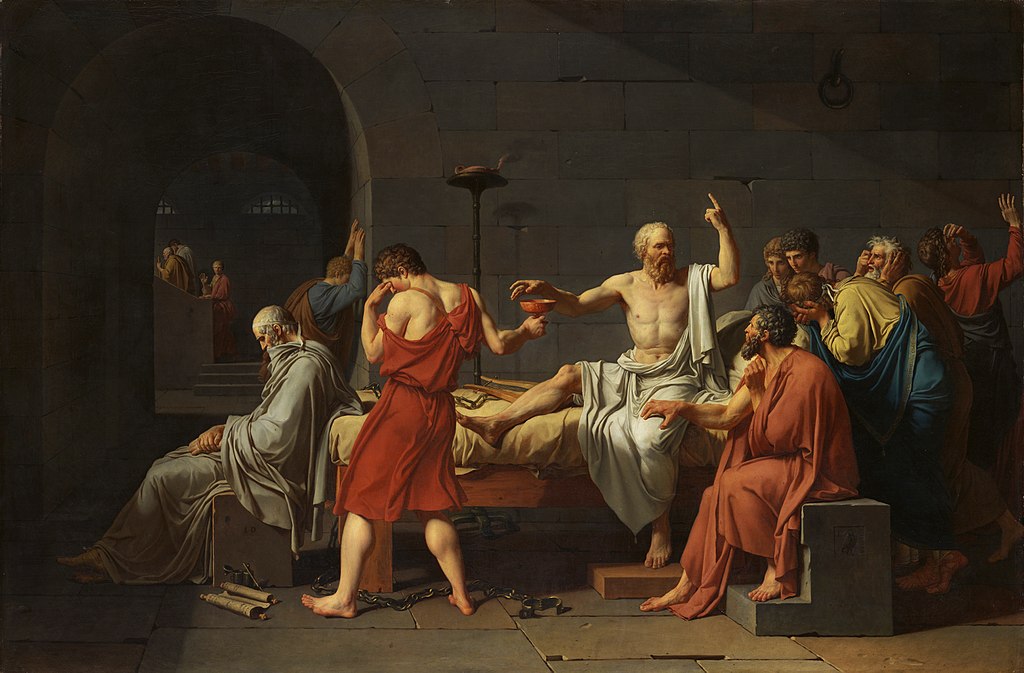
1024px-David_-_The_Death_of_Socrates
The Death of Socrates, by Jacques-Louis David 1787

The picture above is a famous representation of the death of Socrates.  You can find an excellent article on it at the Metropolitan Museum of Art, New York, where it now hangs: just click here.   I’m not going to discuss this painting, especially as someone else has done it so well.  I’m more interested in why death-bed paintings were a popular genre up until the twentieth century.  The idea was not to take a ghoulish pleasure in death but to draw inspiration from people who ‘died well.’   Subjects tended to be people who sacrificed their life in a noble cause, or people who set an example of how to live so as to die without fear or regret.  Socrates ticks both boxes.

Death-bed scenes moved completely out of fashion in the twentieth century, as the so-called ‘first world’ moved death out of homes and into hospitals.  The care of the dying and the clothing of their bodies for burial became a professional job.  Far from families and whole communities gathering at the death bed, it became increasingly hard for them to be present.  In a society where most people can spend years without coming into contact with a significant death, and will perhaps never see a dead body, many people are uncomfortable with the topic of death.  Social approval has moved towards ‘remembering how they were when they were alive.’  Remembering how they died can be seen as unhealthy and even disrespectful; at the very least it is something private and personal.  Medical attendants have replaced family at the bedside, protecting the dying person from being disturbed by grieving relatives.

People in the ancient world rarely got a chance to die privately.  In Ancient Greece the women of the household usually cared for the sick and prepared the body for the tomb – along with any other local women who came to help.  No-one could be unfamiliar with death, especially as life expectancy was fairly low, and a death-bed was somewhere for friends and family to gather.  It was essential for loved ones to be there to kiss and embrace the dying person in farewell, even catching the last breath in their mouths.  And a member of the family was needed to close the eyes and place a coin in his mouth to pay for his passage across the river Styx into the land of the dead.  There was noise too, as pans were shaken to ward off evil spirits.  Death was a  big event.

1024px-Gela_Painter_-_Black-Figure__Pinax__(Plaque)_-_Walters_48225
Prothesis – the lamentation over the body – shown on a 6th Century BC votive tablet by the Gela Painter

Deaths in battle were also frequent and obviously public.  Thinking about the soldier will help us understand the ancient way of thinking.  A solider had to live bravely and die bravely – a man’s whole moral character was in question if he faltered at the end.  Such a man was a risk to his comrades  In the ancient Greek world, there were no professional national armies.  All  free men were expected to fight from their late teens.   The idea of living so that you can die well, without fear or regret, was an obvious concern for everybody.  It was bad enough for a man to fall in battle – what could be done with someone who deserted his friends and neighbours, or was too terrified to fight?

Socrates thought the Athenians should take seriously the idea of living so that you can die well, whether you died in battle or not.  On the battlefield, it is easy to know what to do – stand your ground and fight.  The question is, what is it you have to do off the battlefield?  This was Socrates’ area of expertise.  For him, the key was knowing what was truly good.  People mess up their lives by fearing the wrong things, like death and poverty, and wasting their efforts chasing things they imagine are good.  This is why people need to examine their beliefs and test them.  As long as people believe a hotch-potch of things which don’t connect to reality, it is not surprising that they are going to make terrible decisions.

So the first thing is to make people question their beliefs to see whether they make any sense.  The aim is not to keep questioning for ever.  The questioning has two purposes.  First of all, you need to clear out all the wrong ideas which clutter up your head and make you incompetent at running your life.  Secondly, you need to ask questions which will help you discover what the universe is really like, and how you fit into it.  This includes discovering what is good, and worth wanting, and bad, and worth fearing.

Knowing what is good isn’t easy.  But if you find out, the battle is won.  Because Socrates, or at least Socrates according to Plato, believes that virtue is knowledge.  ‘Virtue’ to Socrates means something like ‘excellence at being a person’.  We have the idea that you could be virtuous but unhappy.  Socrates doesn’t.  Being excellent at being a person is the happiest thing you can do; the alternative is being rubbish at being a person, and obviously if you are rubbish at being a person you will be unhappy.  Once you understand your real nature, you can be excellent at being a person and then of course you will be happy.  When you are dysfunctional, and fighting your true nature, of course you are unhappy.

The key is that the perishable universe is mostly a distraction.  You are essentially your soul, an immortal being.  You will flourish once you direct your being towards immortal things, like Beauty, Truth and Goodness; these are real, and give the physical world what stability it has.  The physical world allows you glimpses of reality.  Wherever you perceive pattern, regularity and beauty, you have an opportunity to move your mind away from the physical clutter of the world of sensation, and begin the journey of pure thought into the real world of things which are eternal, which Plato calls the Forms.  Basically, you should do maths, and hang out with mathematicians in your free time.

But because you have a body, you may have some hardware problems.  Your soul is immortal, but it is wearing a perishable body.  It’s possible your soul has got a bit battered through descending into a perishable body.  One problem is that getting born takes away the soul’s memory about its life outside the body.  In addition, the body places constraints on the soul.  The body has to be nourished and protected, and the part of the soul programmed to look after it is glitchy.  Unless you really nurture the highest part of your soul, the bit that is most really you, then your physical desires, which are only intended to keep your body functional, will start taking over.  You will become obsessed with the things the body craves, like food and drink, and lose track of the things that your true self needs.  This causes unvirtuous – non-excellent – behaviour and unhappiness.

So the cure is to nurture the highest part of your soul.  Bring it into contact with the order of the universe by studying maths.  And discuss goodness and truth.  Question what you thought you knew.  Throw out the rubbish ideas and your soul can start remembering Truth and Goodness and Beauty.  Once you remember those things, the material things you once desired will seem unimportant to you.  You only desired them because you were confused.  Your soul was longing for beauty, so you collected beautiful things which reminded you a bit of Beauty itself.  Your soul was longing for goodness, and it got distracted by things which are ‘good’ for the body, like food.  Once you rediscover Goodness itself, you will never crave those trivial things again.  And you won’t fear losing them either, because your soul will possess them all the time.

Death, it turns out, is a fairly irrelevant part in the soul’s journey, where it sheds a body it has been wearing for not very long.  The upside is that the soul will be free from all the ways in which the body limits the soul and keeps it away from Goodness, Truth and Beauty.  There isn’t really a downside.  This is what the characters in the Phaedo discuss.  The conversation leads up to the moment where Socrates proves that it is possible for a human being to live in the way he has described, by going unafraid into death.  His companions grieve, and he tells them off – he has sent the women away, because he knows they will do all the grieving behaviour that women always do.   He has chosen to spend his last moments in his body, as he had lived, contemplating the goodness of the universe with his friends before he leaves for a fuller life, where they will eventually join him.  Why would they spoil this beautiful event with weeping and wailing?

This is why, in the picture by David, Socrates is vigorously teaching on his bed.  He looks strong and active, because his soul is strong and active.  The cup contains the hemlock, which he will drain without fear, regretting only that he isn’t allowed to make a drink offering from it to the gods.  The jailer weeps, as Plato says he did.  According to Plato, Socrates died peacefully.  Some commentators object that death from hemlock is not pleasant or peaceful, but Plato does not say that Socrates suffered no physical pain.  In fact he records that Socrates suffered slow paralysis, and that he covered his face as he waited, only uncovering for a moment to remind his friends to make an offering to Aesclepius, god of healing, in thanks for an easy death.

Many people have found Socrates’ death inspiring.  The important thing isn’t that he was a martyr for his beliefs – although he was condemned for refusing to renounce his teachings.  It isn’t even that he was brave, although heroic death scenes often do celebrate military values, such as the painting of the death of Epaminondas, painted also in the French  neo-Classical style, just seven years after David’s painting.

728px-Laurent_Pecheux_-_La_mort_d'Epaminondas
Death of Epaminondas, Laurent Pecheux, 1795

Epaminondas is definitely dead.  the viewer gets to share in the wonder and the sorrow, but where he has gone, and whether it was all worth it is up to the viewer.  This is a secular painting and celebrates patriotism, fame and glory as noble life goals.

Many death-bed scenes involve famous last words.  The tradition was that the dying person would make a last act of guidance to the people left behind, even just a few consoling words to the family.  Epaminondas said, ‘I have lived long enough, for I have died unconquered.’  Socrates actual last words, about the sacrifice to Asclepius are relatively trivial.  But for Plato, they show how little the prospect of death occupied Socrates mind.  Socrates ‘real’ last words are the whole of the dialogue, the Phaedo, which culminates in and explains his complete indifference to death.

Nobody ever painted pictures of Socrates dead body.  He says in the Phaedo, when asked about his funeral

 “I cannot persuade Crito, my friends, that the Socrates who is now conversing and arranging the details of his argument is really I; he thinks I am the one whom he will presently see as a corpse.”

After this, anyone painting Socrates dead would look a bit silly.  Socrates doesn’t really have a death-bed, since he refuses to accept death as change to anything important.  It is only his companions who have the uncomfortable illusion that he has died, because the body he used to wear becomes empty.  Socrates is teaching them that we are not our bodies and nothing of what they love about their friend is changing.  Plato was not there at the time Socrates died.  Apparently he was ill, but in Socrates’ case, there wasn’t anything exceptional for him to be there for, although it was a shame he missed the party.  Socrates’ death was particularly unreal for Plato, who would continue to converse with him in dialogues for the rest of his life.

Disentangling the Augustan Succession (Part 9 – Swapping Off)

So far we have seen Augustus build a succession of heirs, only to be disappointed by repeated deaths.

His moves in the succession combine four principles, NO MORE WAR, GIRLS ARE MUMS, DADS ARE BEST, AUGUSTUS LOVES LIVIA.

Here is a summary of Augustus’ attempts to provide a succession of strong male heirs.

Augustus lacks a son.  He decides his nephew Marcellus (son of his sister, grandson of his biological father, Gaius Octavius) will make a suitable father for the children of his daughter Julia 1.  This simple plan fails due to Marcellus’ death.

Next he adopts his grandsons, Lucius and Gaius, Julia’s children by another husband.  They die.

Then accepts his unrelated stepson Tiberius, as a father of heirs.  When Tiberius’ marriage to Julia fails, and it is clear that she will have no more sons (in fact she gets banished), Augustus is forced to consider Tiberius as an heir and adopts him.  Augustus really wants a biological heir and so also adopts Julia’s third son by her previous husband, but later rejects him as unsuitable to be an heir.  He has now run out of Julia’s sons, but there are still daughters.

Faced with the prospect of seeing his succession pass out of his biological line to Tiberius, Augustus brings in his great nephew, Tiberius’ nephew, Germanicus, who has descent from Augustus’ sister Octavia.    Germanicus is to marry one of Julia’s daughters and keep the succession in Augustus’ biological family.  Tiberius and his son lack biological relatedness to Augustus.  Tiberius’ son is placed after Germanicus in the succession and given a suitable marriage which will produce children descended from Augustus’ father, but not Augustus himself.

The rest is just swapping off.  Here are the Julio-Claudians who ruled.

In 14 AD Augustus died.  Tiberius succeeded, as planned.  During his reign he killed off several of Augustus’ descendants, including his own ex-wife, Julia 1, Agrippina, wife of Germanicus, and her two elder sons.  Germanicus himself died of disease or poison in 19 BC.  When Tiberius finally died in 37 AD, he had kept the peace for quarter of a century, although the imperial court had become a dangerous place.  His son had predeceased him, possibly murdered by his wife, and Tiberius, now embittered and absorbed in his own world of vice and paranoia, allowed his line to die out.

Since Tiberius’ son was dead,  a son of Germanicus followed him, as Augustus had intended.  A survivor of the massacre of his family, the Emperor Gaius Julius Caesar, known as Caligula was reputedly mad.  His bloody reign ended with his assassination in 41 AD.  The line of Germanicus’ sons was exhausted, although daughters remained. Caligula left no heir.

The next Emperor was Claudius, brother of Germanicus, a descendant of Augustus’ father.  He had never been intended as an heir – he was lame and Augustus viewed him as half-witted.  Tiberius never saw him as a rival, and Caligula made him a figure of fun.  Now, in the confusion of the assassination, he became Emperor.  Claudius already had a son and a daughter.  But in 49 AD Claudius married into Augustus’ bloodline, cementing his claims on the Augustan succession.  This involved incest –  he chose his niece, Caligula’s sister, Germanicus’ daughter, great granddaughter of Augustus himself, and, like Claudius, descended separately from Augustus’ sister .  Names in the imperial household were departing from tradition and becoming very confusing.  So we will call her Agrippina 2, to distinguish her from Agrippina 1, wife of Germanicus.

When the marriage took place, Agrippina 2 already had a son, Nero, by a previous marriage who had a double claim to Augustan descent, both from Augustus and from his sister.  Claudius was only descended from Augustus’ sister.  As a result of Augustus’ back-up heir plans, there were a number of people around with some sort of relatedness to him and his father.

Agrippina 2 was a dangerous bride.  She had survived the killings of both parents and  two brothers, and she had also steered her way through her brother Caligula’s murderous court.  The story is that Claudius could not see through his young wife’s ambition for her own son.  When Claudius’ son died young, it was said he had been poisoned by his stepmother.  Left without an heir, Claudius adopted Agrippina’s son Nero and made him his heir.  As you might expect by now, Nero also married Claudius’ daughter, his stepsister and first cousin once removed.  Their son would be Claudius’ grandson (and his great nephew) and descended in multiple ways from Augustus and his sister.  When Claudius died in 54 BC, allegedly poisoned by his wife, Nero became Emperor.

However, once he became Emperor, Nero’s concern for the Augustan succession was minimal.  There was no grandson for Claudius.  After Nero had established his rule, he murdered his mother and had his wife put to death.  He made two other legal marriages as well as two irregular marriages, but had no children who survived infancy.  In 68 AD his military commanders rebelled and he committed suicide.  Civil War followed and the Augustan succession was over.  Augustus had prevented Civil War for nearly 100 years.  But his concerns for promoting his biological line in the succession had made the imperial family a brutal and murderous place.  The traditional morality which Augustus promoted in his legislation was nowhere more flouted than in the distorted relationships, scandals and cruelties which typified his own family.

Disentangling the Augustan Succesion (Part 8 – Germanicus)

So in AD 4 Tiberius, son of Livia, stepson of Augustus, was adopted into the Julius family and had only Augustus’ unsatisfactory grandson, Postumus, between him and the prospect of ruling Rome.  AUGUSTUS LOVES LIVIA.  But Augustus didn’t love Tiberius that much and he had not finished with the DADS ARE BEST principle.  He soon rejected Postumus and was left with the prospect of Tiberius taking over, and founding his own dynasty, with no biological connection to Augustus at all.  Yet there were still options among his biological family through his sister’s daughters.

Essentially, Augustus had a good stepson/bad stepson problem, at least, from his own point of view.  Livia’s younger son, Drusus, was the good stepson.  He had never known any father except Augustus – and many people believed he was Augustus’ son, conceived while Livia was still married to her previous husband.  He was a great military commander in his own right, and earned the title Germanicus for his family in battle.  And he had married a daughter of Augustus’ sister Octavia in 16 BC.

In 16 BC this had made sense.  Julia 1 (GIRLS ARE MUMS) and Agrippa were producing numerous children, including the boys, Gaius and Lucius.  Tiberius had been betrothed to Vipsania, Agrippa’s daughter by a previous marriage, almost since she was born – a political match which had nothing to do with the succession.   They married in 19 BC and were happy.  Meanwhile, as a back-up plan for the succession, Augustus decided Drusus could be a father of his own father’s descendants (DADS ARE BEST) and married him to his niece, the daughter of his sister Octavia in 16 BC.  While this fulfilled the AUGUSTUS LOVES LIVIA principle, Augustus didn’t expect to need either of Livia’s sons in the succession.

All this changed with Agrippa’s death in 12 BC, Tiberius’ disastrous marriage to Augustus’ daughter, Julia 1,  and her disgrace and exile.  Augustus had to give up on having a biological grandson in the line of succession.    But Drusus’ successful marriage had produced a potential heir, descended through women from Augustus’ biological father  Gaius Octavius .  This new arrival was  – well, he is always called Germanicus.

800px-MSR_-_Germanicus_Inv._30010
Germanicus

If Drusus had lived, Tiberius would almost certainly have missed out on the succession in AD 4.  He and Augustus had had a terrible relationship since the marriage to Julia in 11 BC.  Drusus could have been adopted as a strong successor and caretaker for his own son, Germanicus.  But Drusus died in 9 BC, reputedly of falling off a horse – another example of the dangers of campaign.   Left without Drusus, Augustus briefly considered making Germanicus his heir, but at barely twenty, he was too young to take over, especially against the opposition of his now wicked uncle, Tiberius.

But the future was with Germanicus.  Let’s not forget Julia 1’s daughters (GIRLS ARE MUMS).  By now, Augustus had given up on marrying Tiberius to anybody.  But Julia’s daughters were still available for marriages and their children would be great grandchildren to Augustus himself.   He was set on Germanicus, already a great nephew via Octavia, marrying one of Julia’s daughters and fathering his great grandchildren.   So Augustus came up with a complicated plan.

In AD 4 Augustus forced Tiberius to adopt Germanicus, his nephew and to make him his heir above his own son.  Augustus finished the plan by marrying Germanicus to one of Julia’s daughters, Agrippina.  Now everything would unfold as if Drusus had lived, with Tiberius filling in until Drusus’ son took over.

Augustus was following the four principles.

Germanicus (DADS ARE BEST) was descended from Augustus’ father, Gaius Octavius, through Octavius’ daughter Octavia, and her daughter Antonia (GIRLS ARE MUMS).  So he was descended both from Livia on the one side (AUGUSTUS LOVES LIVIA)  and Augustus’ father on the other.  By the marriage to Agrippina, Augustus’ granddaughter, Germanicus’ children could be descended from Augustus himself.  So Germanicus’ children would be Augustus’ descendants, Gaius Octavius’ descendants, and also Livia’s descendants in a mixed Julio-Claudian succession.  As a promising young commander, Germanicus would soon be able to ensure the NO MORE WAR principle for himself.  And meanwhile Tiberius would be  get to rule for life, but he would not get to found a dynasty.  All this might have made sense on paper, but it took no account of psychology.

What about Tiberius’ son?  Well, like Tiberius, Tiberius’ son wasn’t biologically connected with Augustus at all.  He had a place in the succession too – Tiberius was allowed to adopt him as a Julian and junior heir after Germanicus.  And a marriage was made between Tiberius’ son and Germanicus’ sister.  This gave Augustus another chance to bring his father’s line into the succession even if Germanicus died without heirs.  After Tiberius would come his son (unrelated to Augustus) and then his son (descended from Augustus’ father).   But Germanicus and his line came first.

Tiberius came off worst in these arrangements.  having been forced to divorce his son’s mother to marry Julia 1, he now found his son virtually disinherited.  He had to treat his nephew, Germanicus, as senior in his household to his own son – a humiliating position.  And he became a wicked uncle to Germanicus, knowing that his own son could only succeed if Germanicus’ line failed.   When Augustus made these arrangements,  he was signing a death warrant for his granddaughter Agrippina and two of her sons, who would be wiped out, along with other potential rivals, in the reign of Tiberius.  Germanicus himself would die of poisoning on campaign in 19 AD.  But Germanicus would eventually contribute two Emperors to the succession – his son Caligula and grandson Nero.

We are now ready for the final post; Part 9 – Swapping Off.

Disentangling the Augustan Succession (Part 7 – the Fourth Principle)

In AD 4 Augustus was faced with the death of both his heirs, the sons of Julia 1, and the lack of a credible regent.  He revised his position.

Julia still had one son left -her youngest, Postumus Agrippa.  So Augustus adopted this boy, whom he had previously ignored.  The sources suggest there was some deep-seated objection to Postumus,  possibly because he had some sort of disability or mental illness.  Postumus did not remain an heir for long – he was banished in AD 6.

Livia heart

But Augustus also made a much more interesting move.  While focusing his hopes on Gaius and Lucius, Augustus had kept on devising  back-up plans involving brutal political marriages and divorces.  Let’s go back in time.  When Agrippa died in 12 BC, Julia 1 was still young enough to become the mother of even more heirs.  Augustus hoped not to need them – he had Gaius and Lucius, her sons.  But on the GIRLS ARE MUMS principle Augustus felt Julia should continue to ensure his succession with back-up sons, and picked another suitable husband.

So in 11 BC, Julia married her stepbrother, Livia’s elder son, Tiberius.  He was indeed strong enough to enforce the NO MORE WAR principle, but his choice over other candidates was obviously to please Livia.  AUGUSTUS LOVES LIVIA.   To make this marriage,  Tiberius was made to divorce his beloved wife, the mother of his son, and marry Julia against his will.  The marriage with Julia was a disaster and produced no children.  Julia’s career as mother of heirs was over.  By 6 BC, Julia and Tiberius had separated and in 2 BC she was disgraced and sent into exile.  Augustus would have to make the best of her children by Agrippa.   At the time, with Gaius and Lucius shaping up excellently, this didn’t seem much of a problem.

But in AD 4, the situation was much more urgent.  Augustus did something much more radical than just trying out the unsuitable Postumus as an heir – he adopted his stepson, Julia’s ex-husband, Livia’s elder son Tiberius, bringing the Claudius family into the succession.  Like Agrippa, Tiberius was no biological relation, but an experienced commander and able to uphold the NO MORE WAR principle.   This helps explain how he got chosen to marry Julia.  But that doesn’t explain his adoption in his own right, after it was clear that he would not father Julia’s sons – for that we need the fourth principle; AUGUSTUS LOVES LIVIA.  Augustus was elevating Livia’s son to a position where he might inherit the rule of Rome – something he had not done for either of Julia’s previous husbands.  In fact (spoilers), on Augustus’ death in 14 AD, Tiberius became the Emperor Tiberius.

However, Augustus did not let go of the idea of keeping his own biological family in the line of succession.  Initially, he kept his grandson Postumus in reserve; given the age difference, it is probable that he considered placing him next in the succession after Tiberius, so that Tiberius would hold power in his life, but pass it back to a descendant of Augustus at death.  Even after he finally gave up on Postumus, Augustus would continue to interfere with the line of succession, diverting it away from Tiberius’ natural heirs towards his own biological family.

Disentangling the Augustan Succession (Part 6 – the Children of Julia)

The death of Marcellus ruined Augustus’ first hopes.  But he caused Julia 1 to remarry by 21 BC.  She was 18, her new husband some 25 years older.  The new husband had to divorce his wife, another cousin of Julia’s, to marry her.  In fact the ex-wife was the sister of Julia’s dead husband.  Augustus’ family was becoming extremely complicated.  But it all seemed worthwhile to him because Julia had to be the mother of heirs and she had to have a hand-picked husband.

The husband picked in this case was Marcus Vipsanius Agrippa, Augustus’ second-in-command who had won the crucial Battle of Actium for him in 31 BC, causing the flight and suicide of Augustus’ rival Mark Antony and his consort Cleopatra.  The choice of Agrippa seems to have been purely practical – Augustus needed a regent who could take over and protect his heirs if he died.  On the NO MORE WAR principle, Agrippa was the obvious person to take over, and he would champion the rights of Julia’s children if they were also his own.

Augustus had not abandoned the idea of bringing his own father’s descendants back into the line of succession.  He was arranging other marriages among his kin which we will come back to later.  Augustus did not adopt Agrippa.  His focus was on Julia’s children and their marriages.

Julia and Agrippa had a number of children, many of them doomed to be martyrs to the Augustan succession.   The marriage produced three sons.   Gaius Vipsanius Agrippa (b. 20 BC) and Lucius Vipsanius Agrippa (b. 17 BC) were the first two.  Augustus stretched the law in order to adopt them both in 17 BC; he removed them from their parents, and brought them up in his own household.  As the boys were adopted, they officially took new Julian names.  You will find them listed as Lucius Caesar and Gaius Caesar.  He showered titles and privileges on them and sent them out into theatres of war as soon as they were old enough to get experience.

Gaius and Lucius aureus.jpg
Aureus of Augustus, Lugdunum Mint, 2 BC – 2AD, RIC 209

This coin was recently sold by vcoins.com for $21,000.  It is solid gold – nearly 8 grams.  This was a prestigious coin, celebrating the stability of the succession.  The younger boy put on the adult toga in 2 BC, and died in 2 AD, so scholars think the coin must have been minted in the interval when both were alive and officially adult.  On the obverse is Augustus, with his titles – SON OF THE GOD, FATHER OF THE FATHERLAND, CAESAR AUGUSTUS.  On the reverse, CLCAESARES – GAIUS AND LUCIUS CAESARS.  Above this legend stand the heirs, wearing the toga and displaying shields and spears.  The odd objects floating between them are religious implements.  The message is clear – the youths are ready to take over from Augustus in civil, military and religious life.  Around them are their own titles; SONS OF AUGUSTUS, CONSULS DESIGNATE, LEADERS OF YOUTH.

The coin told one story, reality another, but there was no reason why most people handling the coin should know the true situation.  Augustus presented an image of direct father son succession, cleverly constructed by adoption.  The title ‘leader of youth’ was invented especially for the Senate to bestow on Gaius (5 BC) and Lucius (2 BC), along with ceremonial silver shields and spears, pictured on the coin.  In the days when consuls had been elected from the Senate, a consul designate would usually be a senior general in his forties.  Now, under Augustus, the role was ceremonial.  Gaius was designated as consul in 6 BC aged 14, before he even put on his adult toga.  The next year he put on the toga, was appointed to the elite religious role of pontifex, and was made leader of youth and given a ceremonial military command.  Lucius followed in his footsteps as he reached the same ages.  Gaius held his consulship in AD 1, aged barely twenty.  There was no substance behind the images.

Augustus also married Gaius to his 12 year old cousin Livilla in 1 BC.  She complied with the four principles by being descended through women from Augustus’ sister (DADS ARE BEST, GIRLS ARE MUMS), and by being the daughter of Livia’s younger son (AUGUSTUS LOVES LIVIA).   But she was very young to begin producing heirs and Augustus probably felt there was no urgency.  He focused on rapid military training for Gaius and Lucius instead (NO MORE CIVIL WAR).  By 4 AD they were both dead in foreign lands – Lucius in Marseilles and Gaius in Lycia (Turkey).   Hostile writers suggest that Livia poisoned them, but their deaths are probably more an illustration of the deadliness of the exposure to disease and accidents which was an inevitable part of campaigning.

Amid state mourning in 4 AD, Augustus had to make a new plan.


Disentangling the Augustan Succession (Part 5 – Julia and Marcellus)

Augustus was confronted with the possibility that he would not father the strong male heir he needed under the NO MORE WAR principle.  Employing the GIRLS ARE MUMS and DADS ARE BEST principles where did he go next?

Berlín_Julia_Augusti.TIF
Head of Julia 1

Look at the picture while you think it over.

Julius Caesar, Augustus’ adoptive father,  left no children, especially after Augustus allegedly killed Caesarion, his son by Cleopatra, in 30 BC.

Augustus biological father, Gaius Octavius had one other child, Augustus’ sister, Octavia.

Octavia had a number of children, but the only boy was Marcus Claudius Marcellus, officially a member of the Claudius family, but Augustus’ nephew and the only grandson of Augustus’ dead biological father.

(The noble family of the Claudii was huge.  Marcellus was not closely related to Livia’s sons.)

Yes, like his adoptive father, Julius Caesar, Augustus looked for an heir descended from his own father.  But which father? Augustus did nothing to further the biological line of Julius Caesar.  The father Augustus looked to was his biological father, Gaius Octavius.

So Augustus’ predictable first move (DADS ARE BEST) was a cousin marriage, bringing Marcellus into the succession by (GIRLS ARE MUMS)  marrying his daughter Julia 1 to him in 25 BC.  Now, when and if Julia had a son,  Augustus’ grandson, the boy would be  Augustus’ own father’s great grandson twice over, on both his mother’s and father’s sides; for Augustus, this was the next best thing to having a son of his own.  Augustus didn’t adopt Marcellus because he hoped there was plenty of time for the grandson to turn up in.  There wasn’t.  Marcellus  died childless in 23 BC.

Disentangling the Augustan Succession (Part 4 – Happy Families)

Augustus (Octavian, as he was called until 27 BC) made three marriages.

He made his first marriage was made to cement the uneasy alliance he entered with Mark Antony after Caesar’s death in 44 BC.  The bride was Antony’s step-daughter.  Divorce was rapid, and helped cause a small war.

By the time of his next marriage, 40 BC, Augustus was seeking the alliance of Sextus Pompey, the son of Pompey the Great, who had gained control of Sicily.   The bride was Scribonia, a relation of Sextus’ wife.  She was 17 years older than Octavian and had to divorce in order to marry him.  The alliance with Sextus was short-lived.  The marriage ended in 39 BC; Sextus was defeated and killed in 35 BC.

The marriage to Scribonia produced one daughter Julia; we have to call her Julia 1 because there are other Julias in this story.   Julia 1 was born on the day of her parents’ divorce because Augustus was preparing to marry the love of his life, Livia Drusilla.  Under Roman law, the father took custody, and Julia was brought up by her stepmother.  It turned out that Julia 1 was the only legitimate child Augustus would ever father, making her crucial to his plans.

Livia and Augustus married in January 38 BC.  The marriage was extremely unlikely; Livia’s father and husband had sided with the killers of Caesar against Antony and the young Augustus.  Her father had committed suicide after losing to Augustus in the Battle of Philippi in 42 BC.  Livia was still married to her husband and pregnant with his second child when she and Augustus made a love match.  A divorce was arranged and the marriage took place while she was still pregnant by her ex-husband – a scandal even by Roman standards.

Livia’s ex-husband waived his right to keep their sons; Livia brought them up in Augustus’ household.  The two boys were named Tiberius Claudius Nero and Decimus Claudius Drusus   We will call them Tiberius and Drusus 1.  They were not adopted as children and remained officially members of the Claudius family.  Augustus did not adopt them.

In 27 BC the Senate granted Gaius Iulius Caesar Octavianus the title Augustus.  By this time he had assembled the model Roman family – a strong father (himself), a dutiful wife (Livia), two sons and a lovely daughter.  He used his own family as the model for a campaign for a return to traditional moral values.  But in fact the tensions and divisions which would cause major problems in the succession were already in place.  Augustus had no male heir – and he did not intend to make his stepsons his heirs, although Livia, their mother had ambitions for them.  Julia’s relationship with her stepmother was unhappy, and her value as a mother of heirs in the line of succession destined her for a disastrous future, which begins in Part 5.

Disentangling the Augustan Succession (Part 3 – Dads are Best).

Roman’s had a strong sense of heredity.  They respected their noble ancestors and, in fact, worshipped them.  The images of the family’s dead patriarchs were carried at every aristocratic family funeral and displayed the rest of the time in the atrium,  the great reception hall of the family home.  The faces of the dead ancestors reminded visitors that they were visiting the representative of the genius or spirit of one of the great noble houses – a man whose ancestors held consulships, led great armies and changed history.free-fathers-day-clipart-25

The oldest living ancestor of any branch of a family was called its paterfamilias, the father of the family.    In prehistory he had the powers of an Old Testament Patriarch, and his sons literally lived in his household.  This had all gone; noble Romans maintained their own households, even if the father or grandfather were still living.  But the paterfamilias still wielded enormous authority, and still theoretically had power of life and death over his children – a father actually killed a treasonous son in the year of Augustus’ birth.

So in planning his succession a Roman was looking to carry on the great line of his ancestors as much as, or even more than, his own private bloodline.  If he could not provide himself with a son, choosing an heir descended from his father or grandfather would honour their memory, maintain the bloodline of the ancestors and help transmit the family genius.

We can see this in operation in the case of Augustus himself.  He called himself the son of Julius Caesar – as he was, by adoption.  Caesar never had a legitimate son, and his daughter predeceased him.  He had a son, Caesarion, by the Egyptian Queen Cleopatra, but he had no intention of making him his heir at Rome.  Instead, in his will, he adopted his sister’s grandson.  This followed the two principles GIRLS ARE MUMS and DADS ARE BEST; because he could not carry on his father’s line himself, he carried it through his sister.

In 44 BC Julius Caesar was assassinated.  The young man he adopted, Gaius Octavius, immediately changed his name to Gaius Iulius Caesar Octavianus – the correct way to show he was now a Julius adopted from the Octavius family.  In 27 BC this young man was granted the title Augustus, which he used for the rest of his life.

What about the children of Caesar’s only daughter Julia?  He had made a political match for  her; she married Pompey the Great  who adored her, but she died young in 54 BC leaving no children.  After her death, Caesar and Pompey fought each other in Caesar’s Civil War (49-45 BC), which ended with Pompey’s defeat and death.  Had Julia lived and had a son, maybe things would have been different.

Disentangling the Augustan Succession (Part 2 – Girls are Mums)

Yes, girls cannot be strong male heirs.  In fact they even need a male guardian to manage their business affairs and represent them at law.  Marriage and motherhood is their destiny.

Girl Clip Art #9347 (1)

But as wives and mothers, girls have the capacity to glue aristocratic families together.  Suppose you are an ambitious Julius and you want to make overtures to the Sempronius family.  The ultimate networking move is to marry a Sempronia, a girl imaginatively named after her family, and preferably one with a well-connected father.  These unions didn’t necessarily last very long – the Romans believed in political divorce as well as political marriage.  But the potential of the match went beyond the public relations coup of the wedding.  If the marriage lasted, the children born into it would be of mixed Sempronius/Julius descent, they would have Julian and Sempronian grandfathers, and these patriarchs would unite for important events.  Frequent intermarriage between the same families created important political bonds.

So girls could cement aristocratic families together, providing offspring with ancestry on both sides, creating shared dynasties.  But that’s not all.

Romans were not impeded by Salic Law and Tail Male and all those things which in later Europe meant that property and status missed out girls and their descendants.  Status in the Roman family passed in patriarchal manner from father to son, and in default of sons to brothers and so on.  But property went by the will of the testator.  And men without sons had a special Roman resource – adoption.

In Britain, adoption is of children, and, historically, adopted children could not enter the line of succession.  So even a man as powerful as Henry VIII could not adopt a son, and ran through  6 wives and invented his own Church trying to get himself a strong male succession.  Romans adopted adults.  A man without a son could adopt a suitable young man to take his name.  The adopted son was regarded as equivalent to a son by birth – he took on the family identity and its ancestors became his ancestors.

So where does the girl come in?  Well suppose you have a daughter but not a son.  When you adopt, your daughter marries the new son – this is legal.  Now your grandson will be your biological heir, even if your ‘son’ isn’t.  Perfect.

And what about deciding whom to adopt?  Networking is a factor here.  But you could also consider your own relatives on the female side – your sister’s sons for example.  That way, your new ‘son’ will be biologically close to you, and importantly, descended from your own noble father.  This brings us to Part 3 – Dads are Best